
Cooling
Why Does My House Feel Humid in Fall? 7 HVAC and Home Causes to Check
Mild fall weather can reduce air-conditioning runtime before the moisture outside has disappeared. Here is how to measure the problem and narrow down the likely source.
Quick Answer
A house can feel humid in fall because outdoor air remains damp while mild temperatures reduce the amount of time the air conditioner runs and removes moisture. Measure indoor relative humidity before changing equipment. EPA guidance recommends keeping it below 60%, ideally between 30% and 50% when possible. Persistent readings above 60%, window condensation, musty odors, or damp materials justify checking cooling runtime, airflow, thermostat settings, duct leakage, ventilation, condensate drainage, and possible roof, plumbing, foundation, or crawlspace moisture.
Why Fall Humidity Can Feel Worse Than Summer Heat
Early fall creates an awkward comfort problem in many New Jersey homes. Outdoor temperatures may be close to the thermostat setting, so the air conditioner does not need to run very long. The outdoor air can still carry substantial moisture, especially near the coast. The result may be a room that is technically cool enough but still feels clammy.
Relative humidity also changes with temperature. When air cools without losing water vapor, its relative humidity rises. That is why the same house may feel comfortable during a warmer afternoon and damp later that evening. The number on the thermostat alone does not describe the moisture level or identify its source.
Start With A Humidity Measurement, Not A Guess
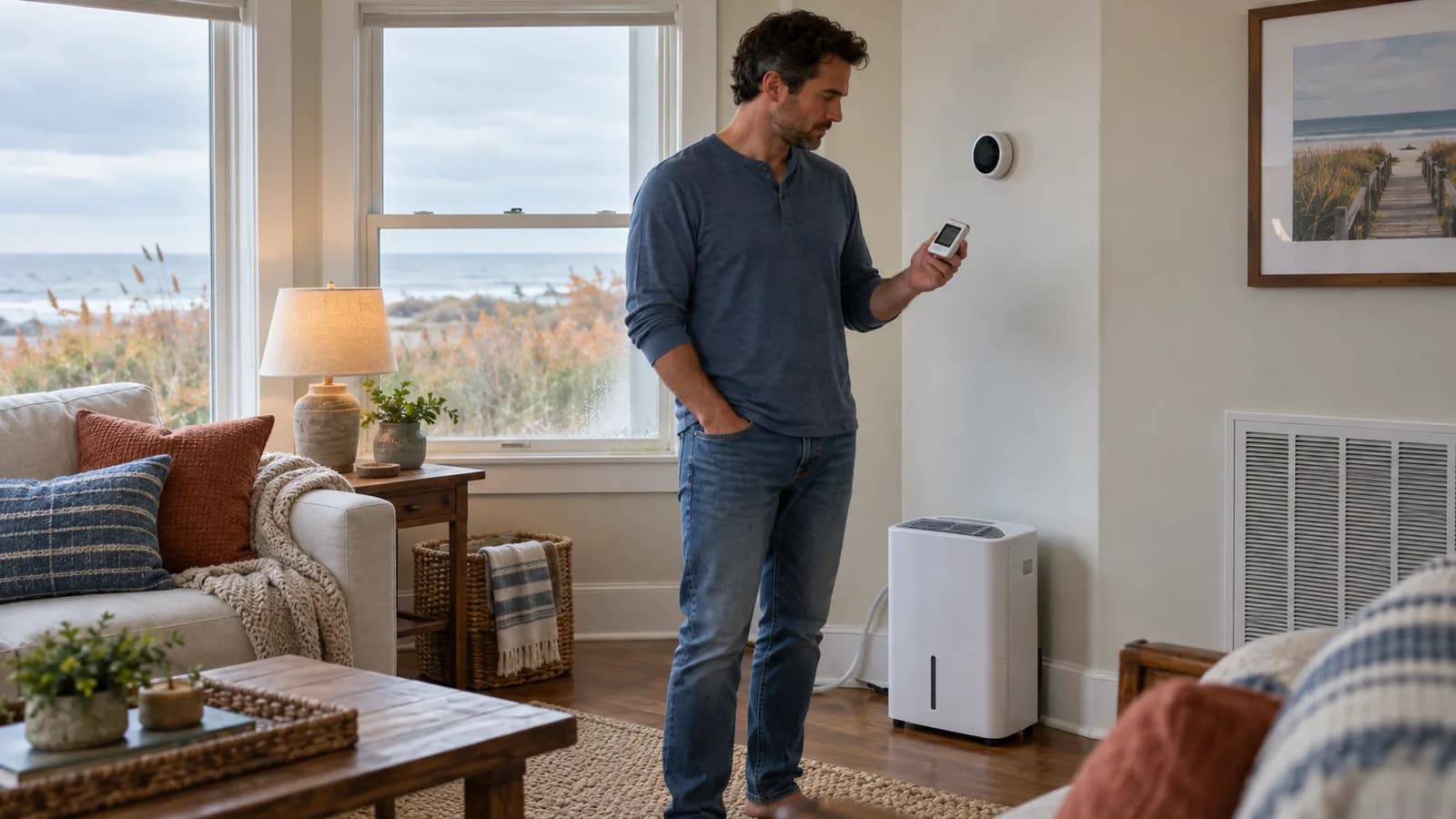
Use a dependable hygrometer or thermostat humidity sensor and record the reading in several locations for a few days. Note the indoor temperature, outdoor weather, whether the cooling system ran, and what was happening in the home. A shower, cooking, open windows, indoor laundry, or a crowded house can create a temporary rise that is different from a whole-home problem.
EPA recommends keeping indoor relative humidity below 60% and ideally between 30% and 50% when possible. ENERGY STAR notes that colder-weather settings may need to be nearer 30% to 40% to limit window condensation. Those ranges are guidance rather than a diagnosis. Sensor accuracy, room temperature, outdoor conditions, and the location of the device all affect the reading.
1. The Air Conditioner Is Running Less
An air conditioner removes moisture when humid indoor air passes over the cold evaporator coil and the resulting condensation drains away. During mild fall weather, the thermostat may be satisfied after a short cooling cycle—or may not call for cooling at all. Less coil time generally means less opportunity to remove moisture.
This does not automatically mean the air conditioner is broken. Compare humidity readings with system runtime and outdoor conditions. If humidity settles after a longer cooling cycle but climbs during mild, damp periods, the home may need a different shoulder-season moisture strategy rather than a lower thermostat setting. Do not make the house uncomfortably cold simply to force more cooling runtime.
2. Restricted Airflow Or A Cooling-System Problem Is Limiting Moisture Removal
A heavily loaded filter, blocked return, closed supply registers, dirty indoor coil, weak blower, or other airflow problem can interfere with normal cooling and dehumidification. Refrigerant or control problems can produce similar comfort symptoms. Water around the air handler, ice on a refrigerant line, weak airflow, unusually long cycles, or repeated starts and stops deserve more attention than humidity alone.
Check the filter only where the homeowner access is designed for it, and keep return grilles and supply registers open and unobstructed. Do not open energized equipment, clean an evaporator coil with household chemicals, or add refrigerant. An HVAC diagnosis should evaluate system operation, airflow, temperature performance, drainage, and controls together.
3. The System Is Short Cycling Or Was Sized Too Large
A cooling system that starts and stops rapidly may lower the temperature near the thermostat without operating long enough for steady moisture removal. Causes can include control problems, airflow restrictions, equipment faults, thermostat location, or equipment capacity that does not match the home. A large nameplate capacity is not proof of better humidity control.
ENERGY STAR warns that oversized equipment may cycle too frequently and reduce comfort, while poor airflow can contribute to overly damp air. Replacing equipment based only on the square footage or the size of the old system can repeat the problem. A replacement decision should consider the home, duct system, insulation, windows, orientation, occupancy, and actual performance.
4. Thermostat And Blower Settings Are Working Against Dehumidification
The indoor fan setting changes how air moves after a cooling cycle. In many conventional systems, AUTO allows the blower to stop when the cooling call ends. A continuous ON setting keeps circulating air and, depending on the equipment and controls, may return some moisture remaining on the coil or in the cabinet to the house. Variable-speed and humidity-control systems may operate differently, so the equipment instructions matter.
Confirm the thermostat mode, fan setting, humidity set point, and any ventilation or dehumidification features before changing them. Smart thermostats do not all control moisture the same way, and a displayed humidity reading can be inaccurate if the thermostat is near a draft, exterior wall, bathroom, kitchen, or supply register.
5. Humid Outdoor Air And Everyday Activities Are Adding Moisture
Open windows are not always a drying strategy. If the outdoor air is more humid than the indoor air, leaving windows open can increase the moisture load even when the breeze feels cool. Bathroom fans that discharge into an attic, a clothes dryer that is not vented outdoors, frequent cooking, long showers, indoor clothes drying, and an improperly controlled fresh-air system can add or retain moisture.
Use bathroom and kitchen exhaust fans that discharge outdoors, and verify that the clothes dryer vent remains connected and clear. Open windows for drying only when outdoor conditions are actually favorable. EPA guidance emphasizes source control: remove moisture where it is created rather than expecting the central system to correct every household source.
6. Duct Leakage Or Unconditioned Spaces Are Affecting The House
Leaky return ducts can pull air from a damp attic, crawlspace, garage, or utility area instead of drawing only from the intended living space. Disconnected or poorly sealed ducts can also change room pressure and encourage outdoor air to enter through gaps in the building. The symptom may be high humidity throughout the home or a problem concentrated near one part of the duct system.
Look for accessible, obvious disconnections without crawling into unsafe areas or handling damaged insulation. An HVAC professional can evaluate duct condition, return-air paths, airflow, and pressure relationships. Air sealing should be coordinated with appropriate ventilation and combustion safety; simply sealing every visible gap is not a complete moisture plan.
7. The Moisture Source May Not Be The HVAC System
A plumbing drip, roof leak, damp crawlspace, foundation seepage, wet building material, or poorly directed gutter can keep adding moisture faster than normal equipment can remove it. Clues include one room that reads higher than the rest, a stain that grows after rain, damp flooring, musty storage areas, condensation on cold pipes, or humidity that remains elevated regardless of HVAC runtime.
Find and correct the water source before treating the symptom with a larger dehumidifier. Express can diagnose HVAC operation and address plumbing or roofing problems within the authorized scope. Mold assessment and remediation are separate services; visible growth, contaminated materials, or significant water damage may require an appropriately qualified specialist after the moisture source is controlled.
What Homeowners Can Check Safely
A short record of conditions is more useful than a single thermostat reading. Measure before buying equipment, document what changes the reading, and stop if a check would require opening electrical or refrigerant components.
Use the following list to prepare for an HVAC appointment or determine whether the moisture points to another part of the house.
- Record indoor temperature and relative humidity in several rooms at morning, afternoon, and evening.
- Note outdoor weather, open windows, showers, cooking, laundry, and the approximate cooling runtime.
- Check whether the thermostat fan is set to AUTO or ON and review the equipment instructions.
- Inspect the homeowner-accessible filter and keep return grilles and supply registers unobstructed.
- Look for visible water near the air handler, condensate pump, ceiling, plumbing fixtures, roof penetrations, or crawlspace access.
- Confirm bathroom, kitchen, and dryer exhausts terminate outdoors rather than in an attic or enclosed space.
- Photograph condensation, staining, or damp areas and note whether they change after rain or equipment operation.
Do You Need A Portable Or Whole-Home Dehumidifier?
A portable dehumidifier can be appropriate for one damp room or a limited seasonal condition. Capacity should reflect the size and dampness of the space, the unit's operating-temperature range, and a safe drainage plan. Keep the air intake and discharge clear, clean the filter as directed, and do not create a trip hazard with a drain hose or extension cord.
A whole-home dehumidifier may make sense when readings remain elevated across multiple rooms despite corrected moisture sources and properly operating HVAC equipment. It must be sized, ducted, drained, and controlled for the home. ENERGY STAR recommends addressing moisture sources first and notes that consistently high readings above 55% throughout a well-sealed home may support a whole-home evaluation.
When To Schedule An HVAC Humidity Evaluation
Schedule service when indoor humidity stays above 60%, comfort does not improve with reasonable source control, or you notice weak airflow, ice, water near equipment, short cycling, unusual odors, unexplained energy use, or rooms with very different readings. Active leaking, a wet ceiling, or water near electrical equipment deserves prompt attention rather than routine monitoring.
Express serves homeowners in Ship Bottom, across Long Beach Island, and throughout Ocean, Monmouth, and Atlantic counties. A useful humidity evaluation should separate weather-related shoulder-season behavior from an airflow, control, drainage, duct, equipment-sizing, plumbing, or roofing problem—and explain the evidence before recommending work.
Frequently Asked Questions
Is 60% Humidity Too High In A House?
A sustained indoor relative humidity reading above 60% is higher than EPA moisture-control guidance recommends. EPA advises keeping indoor humidity below 60% and ideally between 30% and 50% when possible. Confirm the reading with a dependable sensor and investigate the source rather than judging from comfort alone.
Why Is My House Humid When The Air Conditioner Is Off?
Mild fall temperatures may satisfy the thermostat without much cooling runtime, so the system has less opportunity to remove moisture. Humid outdoor air, showers, cooking, laundry, ventilation, leaks, and damp crawlspaces can continue adding moisture while the AC remains off.
Should The Thermostat Fan Be Set To AUTO Or ON For Humidity?
AUTO is generally the better starting point for a conventional system because the blower stops when the cooling call ends. Continuous fan operation can affect moisture differently depending on the equipment and controls. Follow the system and thermostat instructions, particularly for variable-speed or dedicated humidity-control systems.
Can A Dirty Air Filter Make A House Feel Humid?
A heavily loaded filter can restrict airflow and interfere with normal cooling performance and moisture removal. It is one possible contributor, not proof of the cause. Replace or clean only the homeowner-serviceable filter according to its instructions and arrange diagnosis when humidity or airflow problems continue.
Will Turning On The Heat Lower Indoor Humidity?
Heating air can lower the relative-humidity percentage because warmer air can hold more moisture, but ordinary heating does not necessarily remove that water from the house. The reading may fall while the underlying moisture source remains. Ventilation, source control, air conditioning, or dehumidification may still be necessary.
Do I Need A Whole-Home Dehumidifier?
Not automatically. First verify the readings and correct leaks, drainage, exhaust, airflow, or equipment problems. A whole-home system is worth evaluating when humidity remains high across multiple rooms and seasons despite those corrections. It should be sized and installed for the actual home and duct system.
When Is High Humidity An HVAC Repair Problem?
Arrange HVAC service when high humidity appears with weak airflow, ice, water near the air handler, short cycling, abnormal runtime, control problems, or poor cooling. If humidity rises after rain or is isolated near a stain, pipe, crawlspace, or roof area, the primary source may be outside the HVAC system.